
The science held up its end in 2026. The rest of the job, turning that science into companies that can be funded, bought and built, is still ours to do. Nobody is coming to do it for us.
Software didn’t wait for anyone either. It built its own plumbing (cloud computing, open-source code, tools that let a small team ship like a large one) and then used that plumbing to build the next thing. Biotech can do the same. And this time we get to borrow some of tech’s best tools for more than Office 365.
The numbers this year say two things at once. FDA’s drug center had approved 55 novel drugs by November 18, as many as in all of 2023, with six weeks to go. Since July 1, though, the SPDR S&P Biotech ETF, which gives smaller companies far more weight, is down 10%, while the larger-company Nasdaq Biotechnology Index is up 3%.
A flight, a night’s sleep and a run
This week, on a flight back to my hometown, I read the year-end reviews cover to cover. Stifel’s State of Biotech calls 2026 “a strong but selective recovery.” Bruce Booth’s Atlas Venture year in review notes that the industry “hit real turbulence in the fall with the downward pressure of a risk-off trade.” On last week’s Biotech Hangout, the panel landed on a practical lesson: when your data is good, announce the financing right away. They’re good reads, and I learned from each.
I still landed frustrated. Biotech has no shortage of smart people explaining what happened. What the people who have to act get far less of is help deciding what to do on Monday, and by those people I mean the CEOs, the boards and the people deploying the capital. That gap is why I wrote the first draft of this on that flight, and why I spent the rest of it finishing the Mind Club edition of “The State of Biotech.” I wanted it to be the other half of the conversation. Every number is labeled by where it came from, and most are checked against the filing or counted from the public record, deal by deal. There’s a red team that argues against the report’s own thesis and names the tests that would prove it wrong. And there’s a playbook written for the person who has to decide: twelve moves, ten questions for the board, and every financing route that worked this year, with what it costs and when it fits.
Then I slept on it, because I didn’t want to post anything I hadn’t thought through. This morning I lifted weights with my brother, then ran my usual loop. It’s always a bit of a time warp: the route takes me past the landmarks I grew up with. It grounded me, and by the end of it the frustration had turned into something more useful: urgency.
There’s a lot more to unpack, and all of it connects: capital, policy, China, AI, talent. But the thought that stayed with me after that run was simpler. Nike had it right: just do it. My version this morning had an extra word in the middle.
The need hasn’t gone anywhere. Somewhere between 260 million and 450 million people live with a rare disease alone, by the most widely cited estimate, and that’s before the common ones. AI will help us find and test medicines faster. It isn’t going to approve a drug on its own, or decide one is safe, without the rigor this industry built: controlled trials, independent review, inspected plants and safety reporting after launch. That plumbing is why patients can trust what we make. Our job now is throughput: more good programs through it, sooner, without skipping a single check.
Why the urgency
Here’s what I kept coming back to. In one quarter, the four largest AI spenders put about $202 billion into buildings and equipment, by their own filings. Drug developers raised about $86 billion in equity all year, by Mind Club’s count. Those are different kinds of money doing different jobs, and I’m not knocking either. But look at what this industry did with the smaller pile: those 55 new medicines, and more Phase 3 starts than last year.
I don’t read that as an industry short of good ideas. I read it as one that has been disciplined with its capital, and I think the discipline is paying off. Deloitte’s latest study puts the projected return on large-pharma R&D at about 7%, up 1.1 points, though much of that gain rests on obesity medicines. The leaders who kept trials enrolling through a hard fall earned that.
What’s new is how much we can now do with it. The tools tech built for itself are ours to use too. The money that is still moving seems to be going mostly to companies with proof. We have the means, the capital is choosy rather than gone, and the stretch between now and JPM is short. That’s the urgency.
Lay our own plumbing
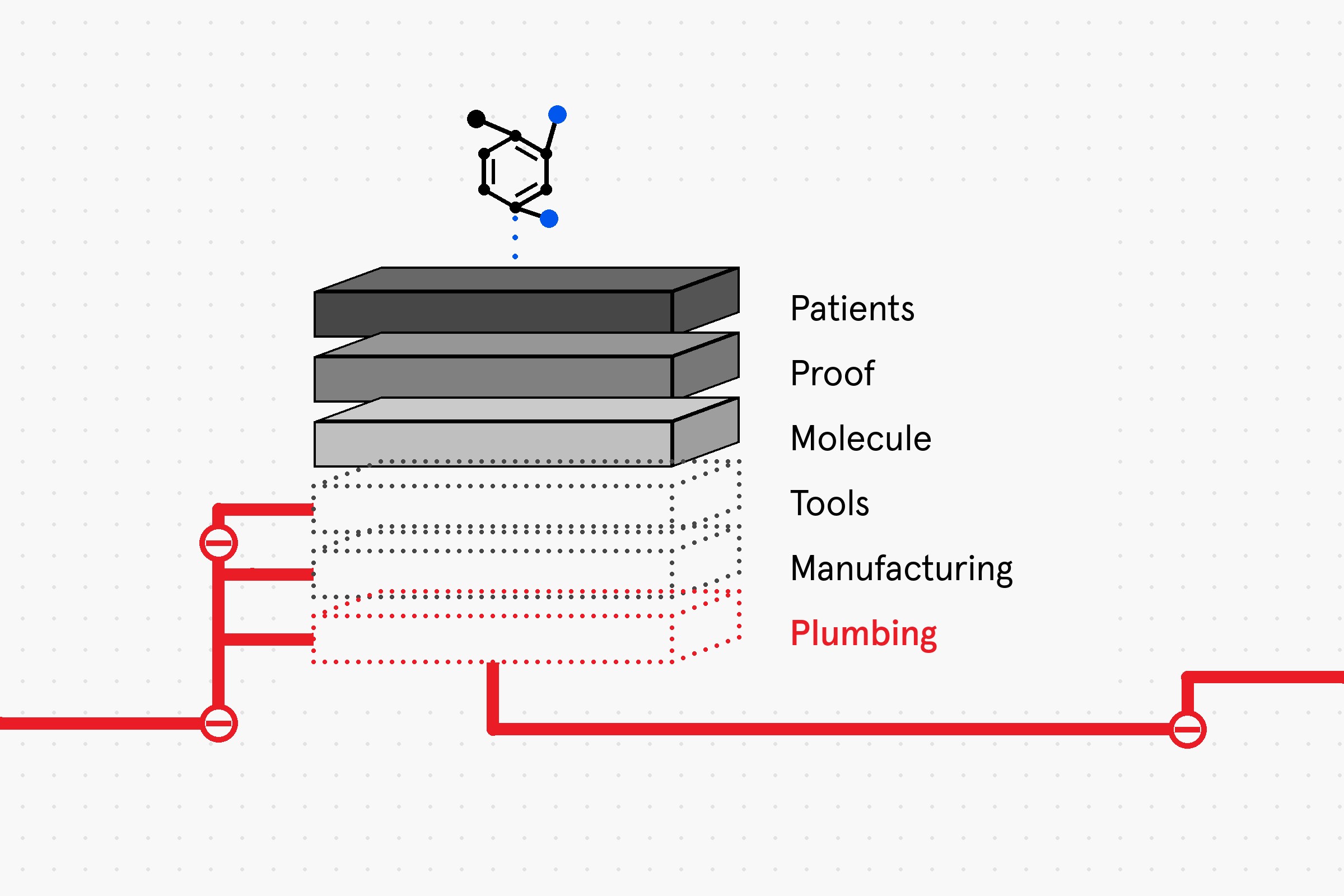
Biotech has a stack, the same as tech. At the top are patients, doctors and payers. Under them sits the clinical proof, then the molecule, then the tools that find and design it, then manufacturing and supply. Underneath it all is the plumbing: capital, data, and the people who know how to run a trial.
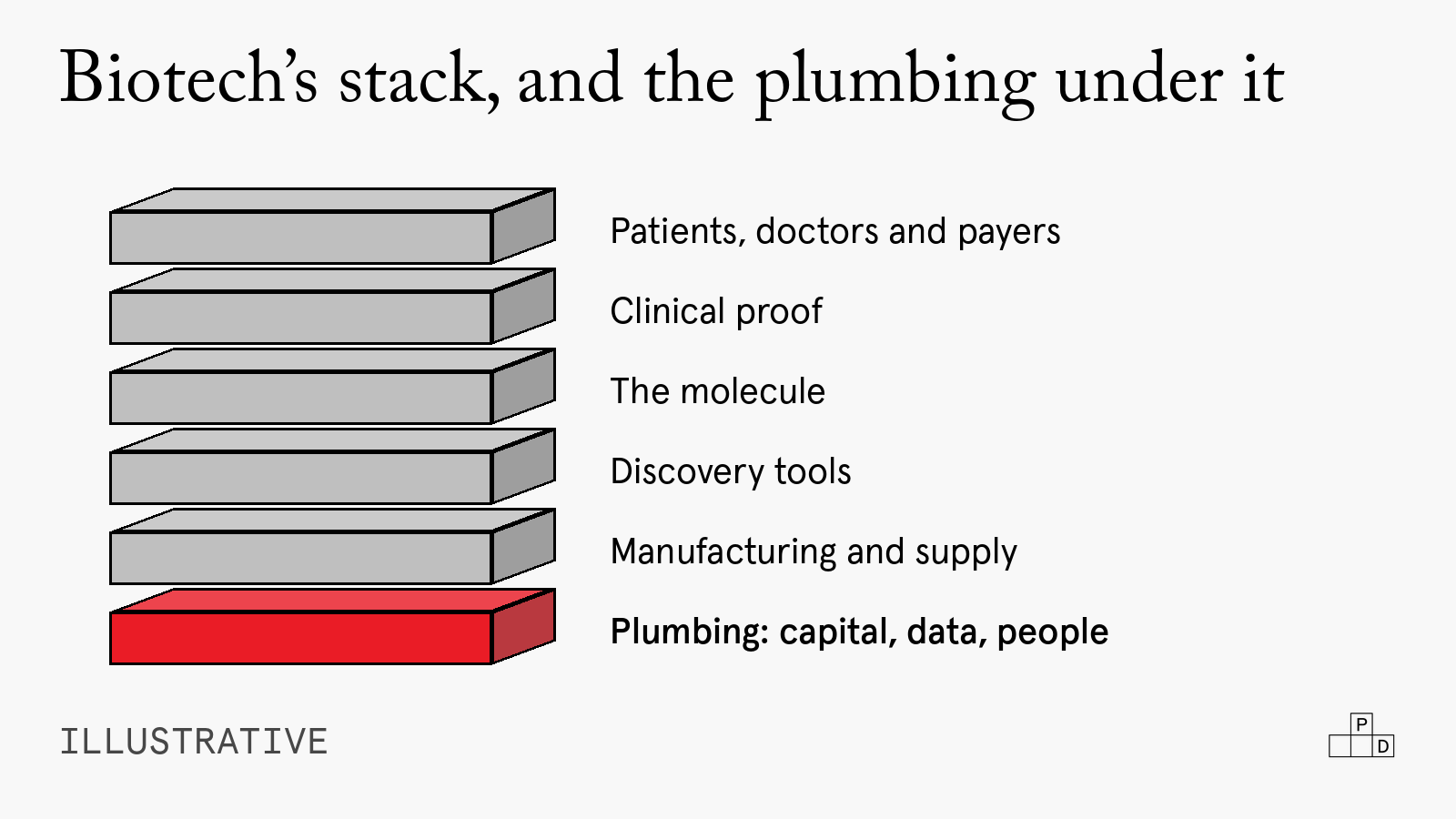
Most biotech companies rent that plumbing. Contract research organizations run the trials, contract manufacturers make the product, bankers find the money, and our own tools rarely go past Office 365. That model works. But it means every company starts from scratch and pays full price for the same lessons.
This time we can build more of it ourselves. Stifel’s team points out that AI can shorten trial execution through patient and site selection, enrollment forecasting and data cleaning, and can take on submission drafting and medical writing, with operating gains that may show up before any change in clinical success rates. Earlier in the chain, molecules described as AI-discovered have passed Phase 1 more often than the industry average, though the sample is small and it isn’t a controlled comparison.
Our largest companies already run the whole stack, and most of us never will. I don’t think we need to. My bet is that the companies that succeed will own one layer so well that the big players have to come to them, and will lay their own plumbing for the rest instead of renting it at full price every time. A small team with good tools, one layer it clearly owns and the pipes in before the pressure comes can stand up to companies many times its size.
Here’s what I think we haven’t done yet, and how we get there.
We haven’t made a success cheaper
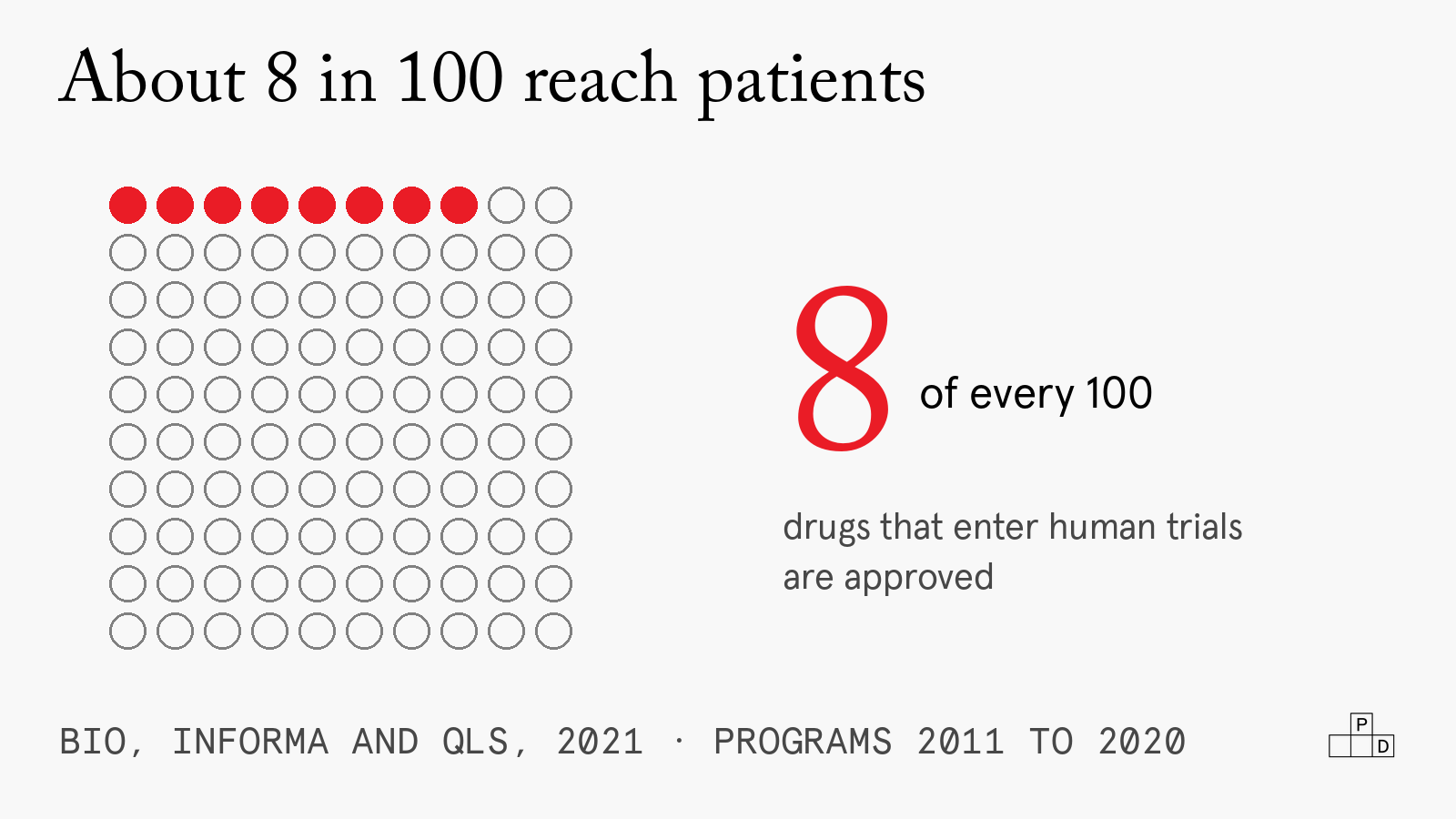
Of 100 drugs that enter human trials, about 8 reach patients, and Phase 2 is where most fall out. Most of what a new medicine costs is the cost of the programs that didn’t make it. The fastest way to bring that down isn’t spending less. It’s choosing better at the start and stopping sooner when the answer is no. AI may help most right here, in candidate selection, chemistry and trial operations, if we measure it by fewer failures and not by press releases.
We haven’t learned to finance on our own clock
The market moves in days. Medicines arrive in years. I’ve been an operator in this industry for more than 20 years, and I’ve learned the most from what went wrong. I’ve been part of large capacity build-outs several times. I’ve seen excess capacity crush the burn rate at a company with no revenue, and too little capacity crush demand at one that had revenue. What I took from both: be surgical about how capacity grows, and have a checklist for when things go wrong, because something will.
Capital is capacity too. Count runway in readouts, not months: does the cash reach the next result that changes your value, with two quarters to spare? Have the shelf and the briefed investors in place before the readout, so good data can be financed within days instead of fading on the screen.
We haven’t insisted on being paid in cash
In Mind Club’s count of this year’s licenses with $100 million or more up front, headline values ran about 12 times the cash paid at signing. Milestones are worth something, but they aren’t cash, and most programs won’t reach them. Negotiate the upfront, not the headline.
We haven’t built for the buyer before the buyer calls
Evaluate puts more than $300 billion of drug revenue at risk from loss of exclusivity between 2025 and 2030. That need doesn’t move with the index. The companies that get bought quickly are the ones ready on the day: clean IP, manufacturing records and a crisp Phase 2 package. Build the data room now.
We haven’t protected the people who do the work
Layoff rounds have slowed to about a third of last year’s pace, by Fierce Biotech’s tracker. The people who can run a Phase 2 well are the scarcest input when capital comes back. Keep the core team.
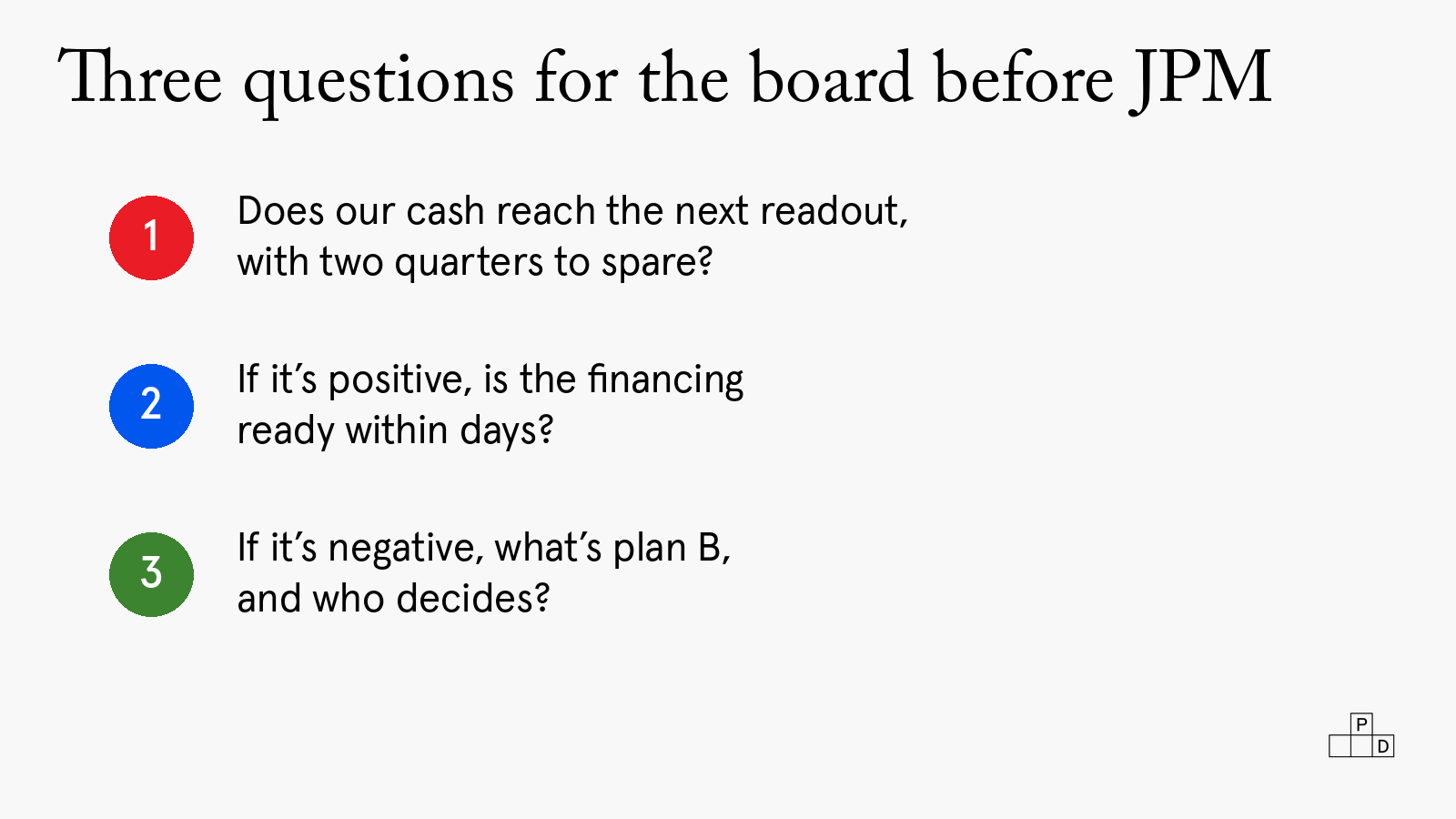
None of this needs the market’s permission. It needs boards willing to ask three questions before JPM. Does our cash reach the next readout that changes our value, with two quarters to spare? If that readout is positive, is the financing ready within days? If it’s negative, what’s plan B, and who decides?
If you want to run those numbers for your own company, I built a small toolkit for it: The Operator’s Toolkit. It counts your runway in readouts, reads a deal’s upfront against its headline, shows what each approval really costs, and turns these questions into a board checklist you can print.
Why I’m hopeful, carefully
The biotech index has lived through three falls of more than a third in the last twenty years. After 2021, the large-company index got back to its peak in November 2025, and the equal-weight fund still hasn’t. Through each of those stretches, new medicines kept reaching patients. Three or four cycles are too few to call a rule, and the market owes nobody a recovery date.
The work that decides 2027 isn’t on the tape. It’s a runway counted in readouts, a data room ready before January, a board that has answered the hard questions, and a team rested enough to run hard after the holidays.
The science hasn’t slowed down. Get some rest. January comes fast.
Tim Opler at Stifel says he’s known as an optimist. After this year, count me as a Timoptimist.
Disclosure: I invest in technology companies and may hold positions, directly or through index funds, in companies mentioned in this piece. This is my personal view, not investment advice, and it does not speak for any company I lead.
Sources
- FDA, Novel Drug Approvals for 2026, checked November 22, 2026; FDA’s 2023 list (55 approvals).
- Nasdaq index and price data, closes of July 1 and November 20, 2026, price returns (Nasdaq Biotechnology Index; SPDR S&P Biotech ETF), and index peaks for 2021 to 2025, as compiled in the Mind Club edition of “The State of Biotech,” November 22, 2026.
- Mind Club counts, January 1 to November 21, 2026: equity financings of $5 million or more ($86.0 billion); licenses with $100 million or more up front (35 deals, $140.7 billion headline, $12.2 billion up front).
- ClinicalTrials.gov, industry-sponsored interventional Phase 3 trial starts, January 1 to November 21 of each year, counted November 21, 2026.
- Microsoft, Alphabet, Amazon and Meta, September-quarter 10-Q filings: payments for property and equipment.
- BIO, Informa Pharma Intelligence and QLS, Clinical Development Success Rates 2011 to 2020 (2021).
- Stifel Healthcare Investment Banking, The State of Biotech, November 13, 2026.
- Bruce Booth, Atlas Venture 2026 Year in Review, LifeSciVC.
- Biotech Hangout, Episode 204, November 20, 2026.
- Deloitte, Measuring the return from pharmaceutical innovation, 2026; Evaluate, loss of exclusivity 2025 to 2030; Fierce Biotech layoff tracker; all as reported.
- Jayatunga and colleagues, Drug Discovery Today, 2024 (AI-discovered molecules in Phase 1).
- Nguengang Wakap and colleagues, “Estimating cumulative point prevalence of rare diseases,” European Journal of Human Genetics, 2020.
Cover and figures: illustrations by Torpedo Publishing.
