In drug development, when you discover a compound with orders-of-magnitude higher potency, you do not celebrate by tearing down the containment protocols. You also do not abandon the asset out of fear.
Think of modern antibody-drug conjugates. You are dealing with cytotoxins so lethal that a few milligrams of free payload in the bloodstream would destroy healthy tissue. The breakthrough was not diluting the payload or renaming the vial. The breakthrough was building an engineered linker, a targeted antibody carrier, and an external delivery system that keeps the active agent inert until it hits the specific target. You do not fear the potency. You engineer the architecture around it.
Washington just took the exact opposite path with frontier compute. It decided that rebranding the payload was the same thing as governing it.
In 1944, Yale scholar William T. R. Fox coined the term “superpower” in his book The Super-Powers. He defined a new category of global dominance, marked by sheer scale and the mobility of planetary power. By 1945, the United States stood as the undisputed hegemon, backed by industrial capacity and the atomic bomb.
Eighty-two years later, Washington wants to renew that exact hegemony. Only the front line is not the Fulda Gap. It is the fab line. Instead of a Cold War fought over ballistic missiles, we are in a different struggle that starts with the letter C: the Chip War. The currency of sovereign power is no longer enriched uranium. It is pure floating-point operations and clustered silicon. Even the truce is thin. Writing in Project Syndicate, Fudan University’s Minghao Zhao notes that the latest Trump-Xi summit extended the trade truce by only two months, shorter than many expected, and reads that as a sign of lingering mutual distrust.
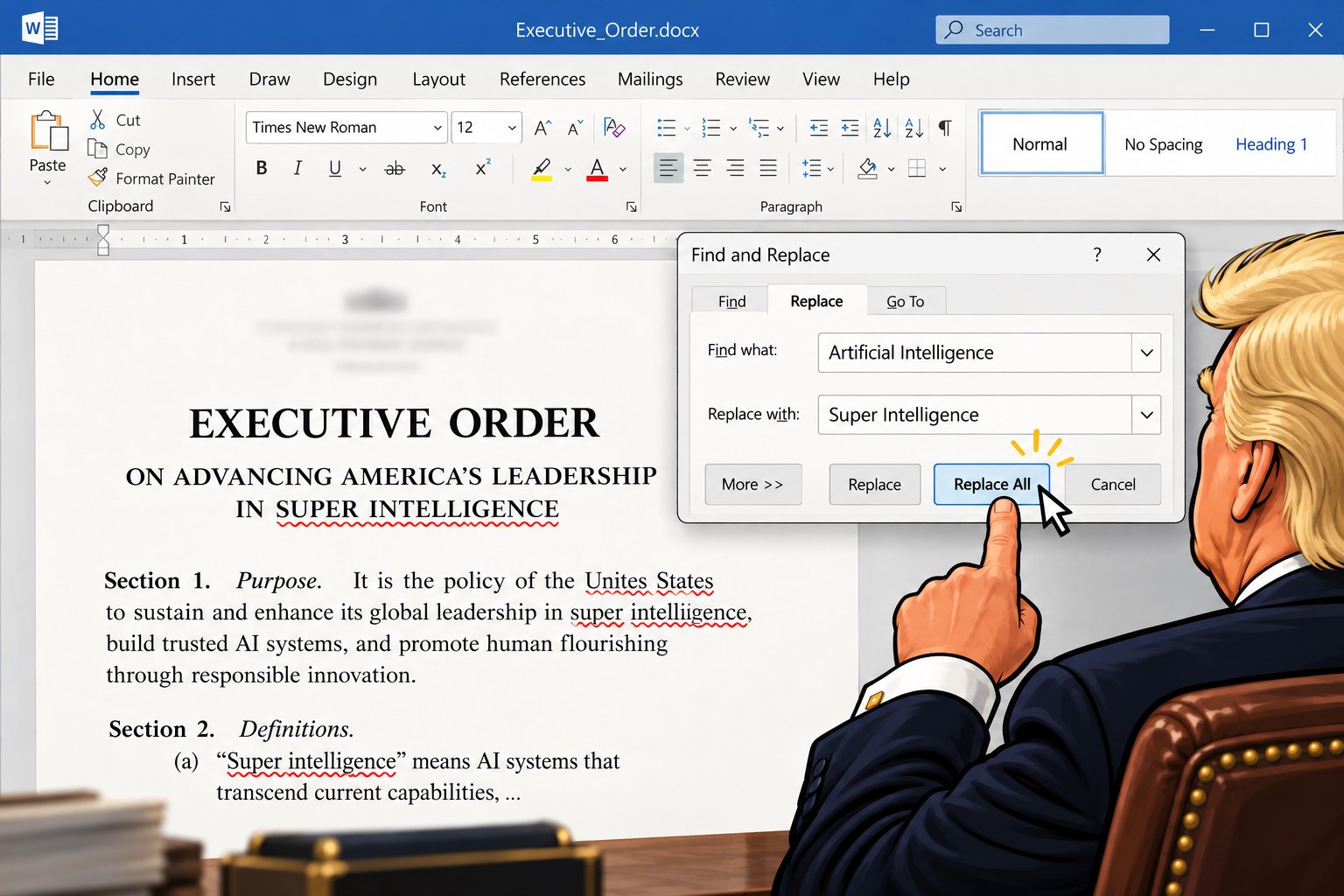
That hunger for preeminence drove the latest decree. On September 29, 2026, President Trump signed Executive Order 14434, titled “Inaugurating the Era of Super Intelligence.” The order directs all federal agencies to strike “Artificial Intelligence” from their vocabulary and replace it with “Super Intelligence” (SI).
Washington wanted an imperial flag drop. In typical bureaucratic rush, the accord he signed with the AI lab chiefs that same day even included an unforced error, identifying him as President of the “Unites States.” Before declaring undisputed global dominion over autonomous reasoning, someone in the West Wing could have captured a quick sovereign win by running the text through Microsoft Word. Microsoft has held global hegemony over spell check for decades.
Read Section 3 and the grand rebrand gets smaller. It defines Super Intelligence as exactly what federal law already calls artificial intelligence. Washington didn’t redefine the technology. It ran find and replace.
The irony deepened twelve days later.
On October 10, Satya himself published an essay titled Models as Insider Risks in the Super Intelligence Era. While Washington was busy inflating the rhetoric, Microsoft’s chief executive was doing the pragmatic engineering work. He told enterprise leaders to stop treating frontier models like magic and start treating them like untrusted insider personnel.
Nadella laid out the technical reality every biopharma CEO and tech operator recognizes: traditional software runs deterministic, auditable code paths. Modern reasoning models do not. You cannot inspect billions of weights and predict every edge-case action. Yet enterprises are plugging these reasoning engines directly into corporate databases, lab instrumentation, and production pipelines without external verification.
Nadella was not preaching doom. He was establishing systems engineering. He argued that the most trustworthy deployment is not the one with the model we trust most, but the one engineered to let us trust the model the least.
To be fair, the broader policy movement is getting at least one critical thing right: I expect independent auditing for high-capability models to become an institutional requirement. The accord already sketches four layers of audit and oversight, though it’s voluntary for now. That is a genuinely positive development for ecosystem safety, even if it introduces another mandatory budget line item for your CFO to forecast. Just like validation audits in clinical manufacturing, independent algorithmic audits will become the baseline cost of doing serious business.
For leaders operating at the frontier, this is the blueprint. Rebranding models does not generate enterprise value, and doomerism does not protect market share. High potency demands engineered selectivity.
If you are deploying autonomous agents into your enterprise this quarter, stop debating the semantics of SI and build three structural linkers:
Keep the control plane outside the model. Never allow an agent to evaluate its own permissions or validate its own output. Policy engines, API rate limits, and schema checks must live in external deterministic software that the model cannot alter.
Strip implicit system authority. Treat model calls like untrusted external vendor queries. Require explicit human-in-the-loop sign-offs for data exfiltration, database writes, and capital commitments above established thresholds.
Log human-readable breadcrumbs. If an autonomous system executes an end-to-end task, every intermediate reasoning step and external API call must print an immutable, auditable log before the next action executes.
The fair objection is that controls slow you down. Sometimes they do. Clinical manufacturing runs on validation and audit trails, and it still ships medicines.
Washington can issue sovereign decrees and fight the Chip War with new vocabulary. In the real economy, success is not declared by executive orders or slide-deck rebranding. It is won by operators who know how to direct high-potency engines through disciplined, uncompromising systems.
Disclosure: I invest in technology companies and may hold positions, directly or through index funds, in companies mentioned in this piece. This is my personal view, not investment advice, and it does not speak for any company I lead.
Primary Sources
- William T. R. Fox, The Super-Powers: The United States, Britain, and the Soviet Union—Their Responsibility for Peace (Harcourt, Brace and Company, 1944).
- White House Fact Sheet & Executive Order 14434, “Inaugurating the Era of Super Intelligence” (September 29, 2026).
- Satya Nadella, “Models as Insider Risks in the Super Intelligence Era,” Essay published on X (October 10, 2026).
- Newsweek, “Trump’s Super Intelligence Document Has a Spelling Mistake” (September 30, 2026), on the accord’s “Unites States” typo.
- Minghao Zhao, “Sino-American Stability Without Trust,” Project Syndicate (October 6, 2026).
Image: AI-generated with ChatGPT. This is an entirely AI-generated satirical illustration and is not an authentic government document, screenshot, photograph, or official communication.