
The machine that missed this Ebola outbreak was working perfectly.
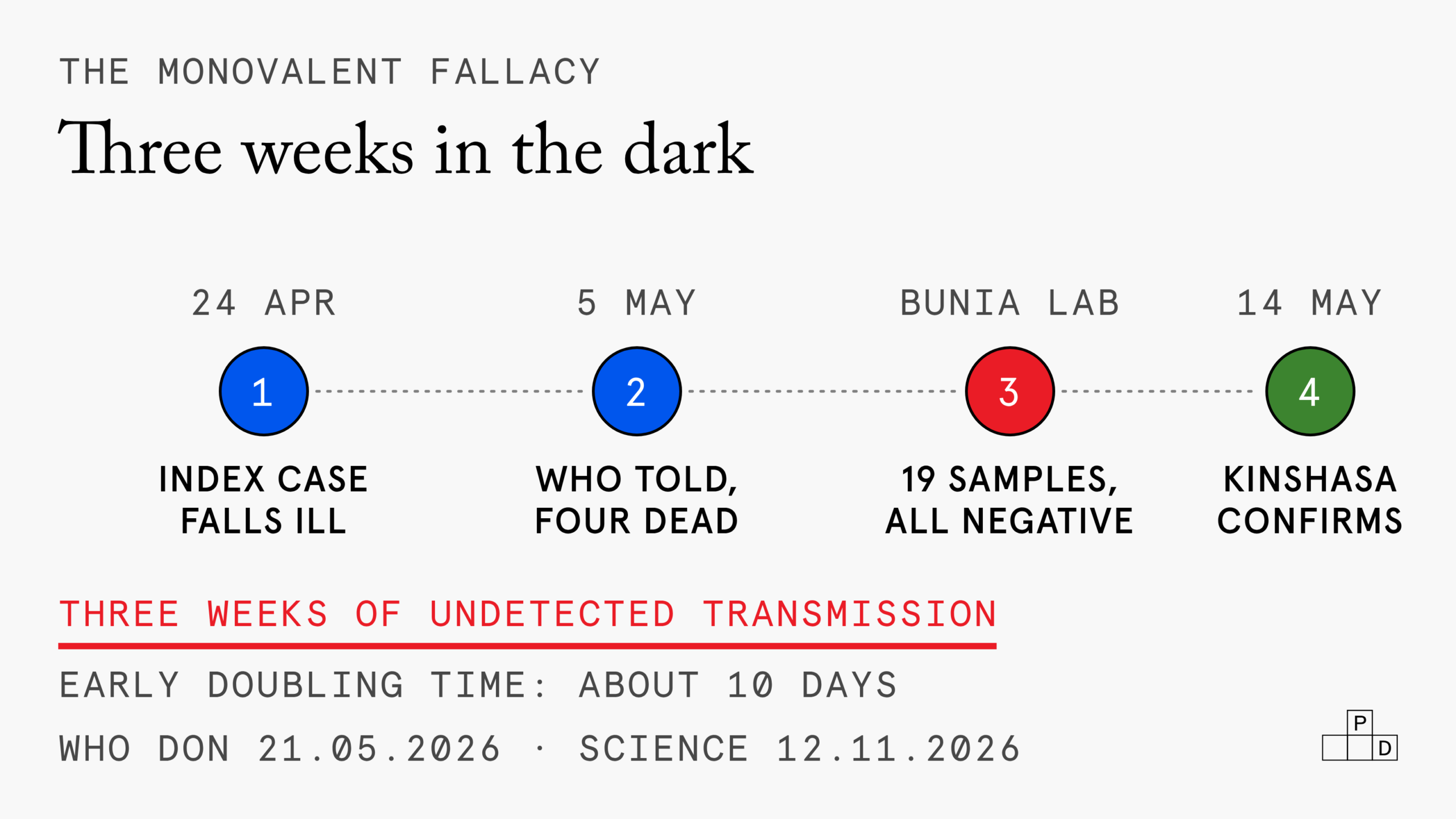
On May 5, a provincial laboratory in Bunia ran blood from nineteen people who were suspected of having Ebola. Every sample came back negative. The cartridge inside that machine was built to find Zaire ebolavirus, and the virus killing people in Ituri was Bundibugyo, a cousin whose surface glycoprotein differs from Zaire’s by about 37 percent at the amino acid level. To a test looking for one sequence, that is not a near miss. It is a different question.
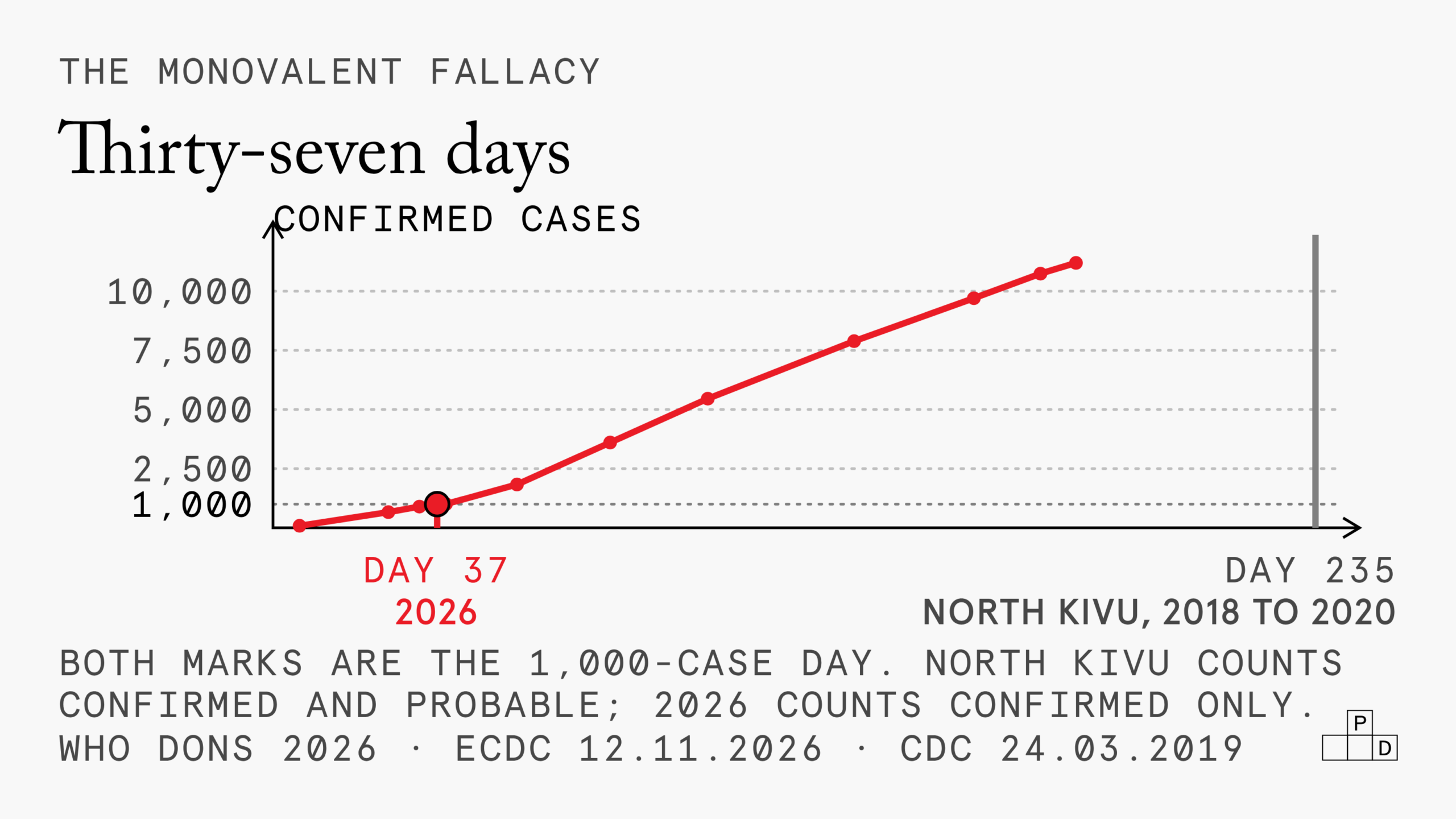
Nine days later, sequencing in Kinshasa named it. By then the outbreak had a head start of about three weeks. A paper published in Science two days ago puts an early doubling time of roughly ten days on those first weeks, which means the delay was worth about two doublings before anyone knew what they were fighting. As of November 12 the Democratic Republic of the Congo has recorded 11,197 confirmed cases and 5,471 deaths, a crude fatality rate near 49 percent. It is now the second deadliest Ebola outbreak ever recorded, behind only West Africa in 2014.
I have been circling this problem for most of my career. At Inovio I worked on vaccines for dengue, chikungunya, SARS, flu and a long list of others. There was money then, a lot of it, from NGOs who had decided these diseases mattered. What I remember most clearly is not the science. It is how often the hard question in a room full of smart people was not whether we could build something, but who on earth was ever going to buy it.
That question has an answer for Zaire ebolavirus. It did not have one for Bundibugyo.
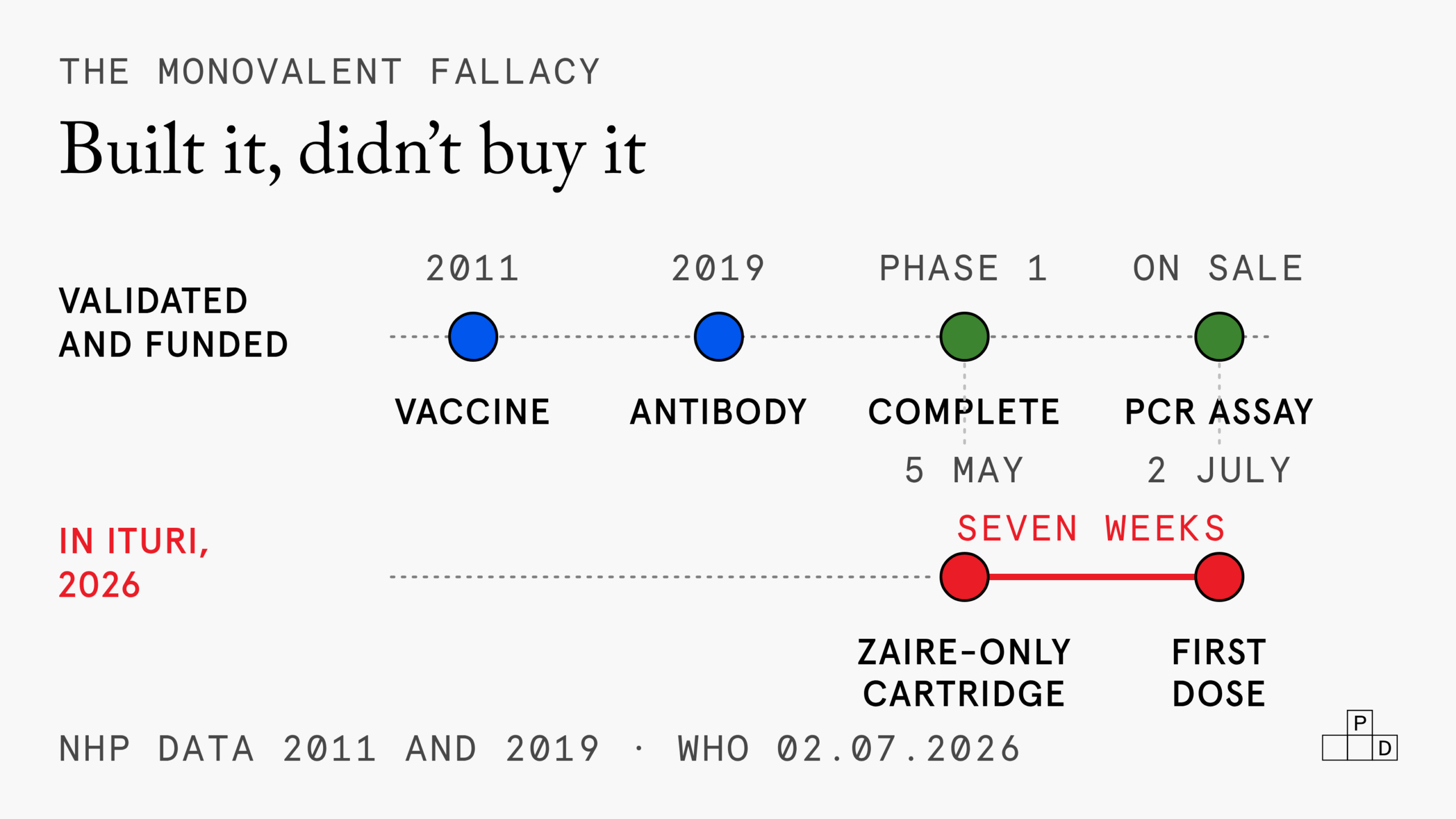
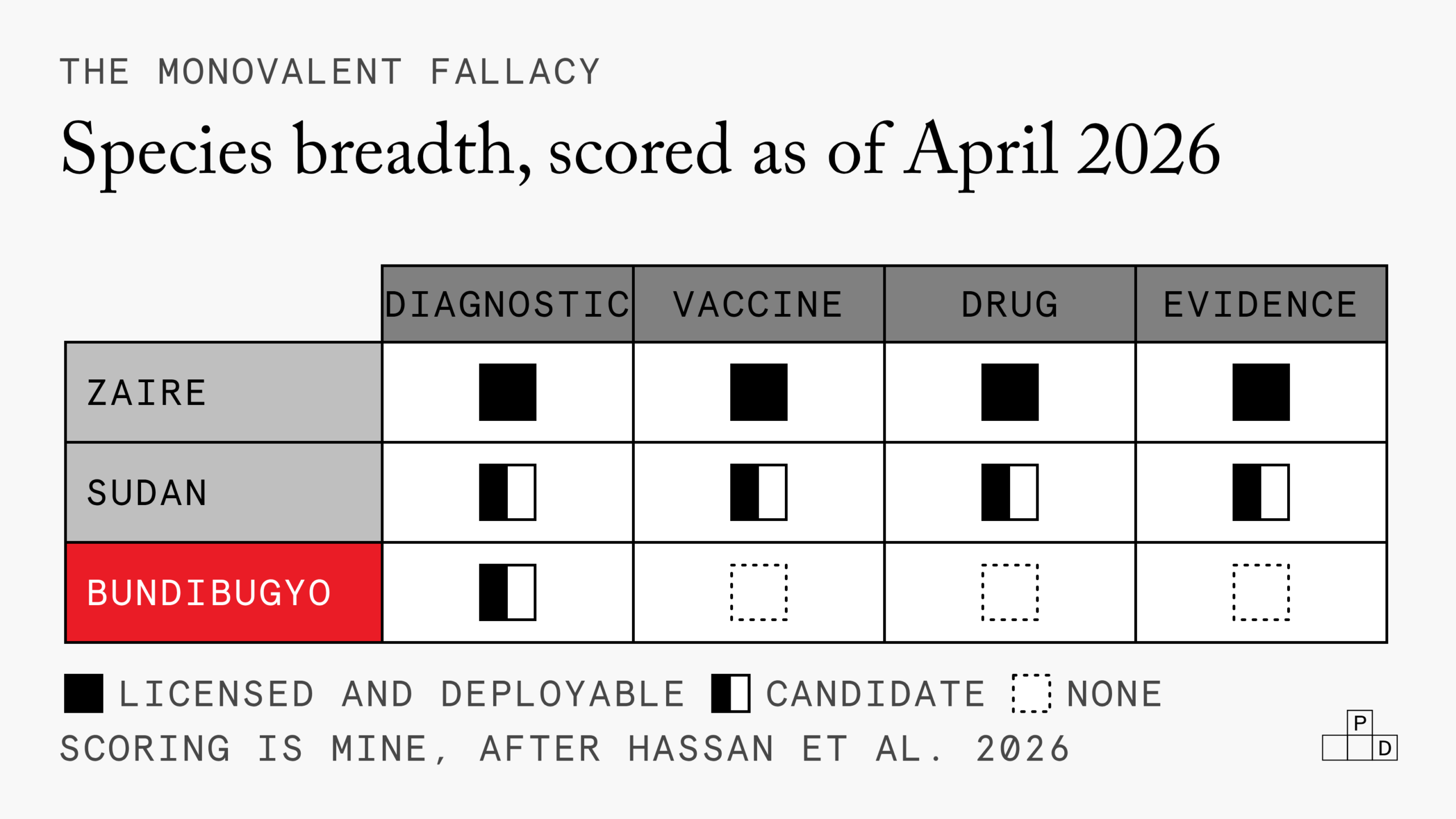
Here is what existed in April, before anyone in Ituri got sick. Published work from 2011 showing that a single dose of a Zaire vaccine let three of four macaques survive a Bundibugyo challenge. A pan-ebolavirus antibody cocktail, MBP134, which neutralizes every Ebola species in the dish, protected five of six macaques against Bundibugyo where all three untreated animals died, and had already cleared a Phase 1 safety trial in healthy volunteers. BARDA funds its advanced development. A pan-filovirus PCR assay, commercially available, that looks for the whole family rather than one member.
None of that was in Bunia on May 5. The first patients were not enrolled in a trial of that antibody until July 2, seven weeks after the outbreak was declared.
It gets worse the longer you look. In October, with the outbreak past nine thousand cases, a preprint reported that one of the three antibodies inside the licensed Zaire treatment protects monkeys against Bundibugyo on its own. That work has not been peer reviewed yet, and it may not hold. But the molecule has been sitting in a licensed product since 2020. Nobody had checked, because nobody was paid to check, because no procurement document ever asked the question.
So the story people are telling about this outbreak, that we neglected the science for the neglected species, is not quite right. The science got done. Some of it got done with American money. What never happened is the dull part after the science: somebody buying the thing, writing it into the standard for what a field laboratory stocks, putting it on a shelf in Kinshasa, and agreeing in advance on the protocol that lets a doctor give it to a dying person in week one instead of week seven.
The money explains how we got here better than any story about hubris. Global Ebola research and development funding fell from $679 million in 2015, the year after West Africa, to $98 million in 2024. Over the same stretch the US government’s share of it rose from 42 percent to 88 percent. Of 94 filovirus candidates being tracked this year, at least 50 target Zaire, 22 target Sudan, 38 target Marburg, and none target Bundibugyo.
Sit with the 88 percent for a second. When one government is nearly the entire buyer, its taste is not a preference. It is the world’s capability.
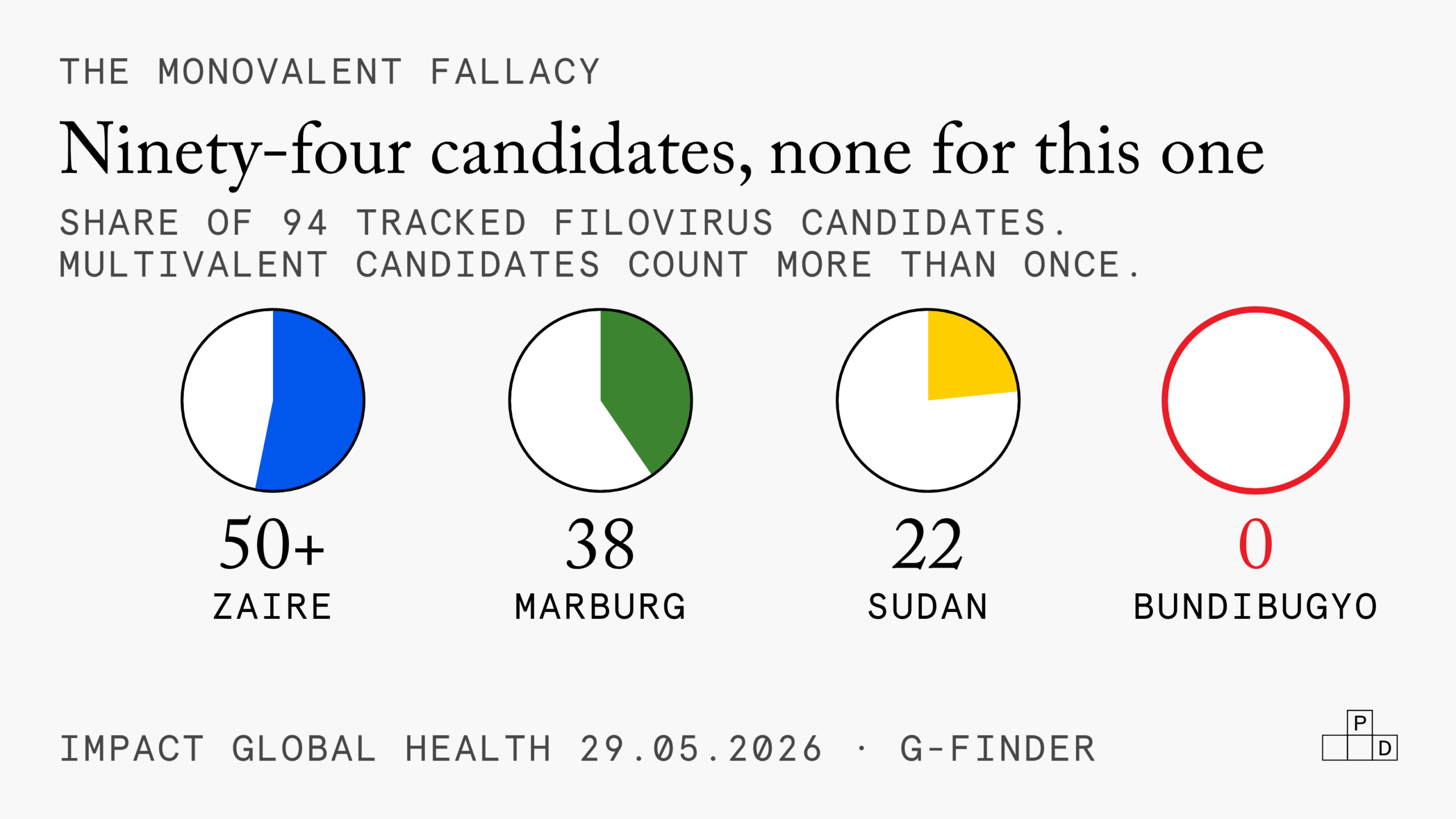
And a government stockpile is a strange buyer. It is purchasing a product with one customer, no commercial market, and no revenue in any year when the thing works. In that situation the award criteria stop being a filter and become the entire product specification. Nobody writes “must also work on the species we have not seen since 2012” into a scoring sheet, because that costs real money today against an outbreak that will probably land on somebody else’s watch. So the narrowest asset that clears the bar wins, every time, and then the same logic repeats one level down, at prequalification, and again at the cartridge in the machine in Bunia.
Breadth gets funded as research, where it is cheap and publishable. It does not get bought as inventory, where it is expensive and boring. That is the whole failure, and it is not a scientific one.
None of which is an argument that Washington is the only actor here, because it is not. Africa CDC and the WHO launched a joint continental response plan on June 5, budgeted at $517.7 million across fourteen pillars, and African Union members pledged roughly a tenth of it. That plan nominally runs out this month, and as I write no extension has been announced. The people closest to this outbreak built the right structure and have spent six months asking the world to fund it.
The strongest argument against me is worth stating properly, because serious people hold it. It is called prototype-pathogen preparedness: pick one virus per family, characterize it completely, build tools against it, and rely on the family resemblance to carry you part of the way to the rest. A review in the New England Journal in June held that animal studies, human serology and antibody work suggest Zaire-based tools may cross-protect against Bundibugyo. A Lancet cohort of 1,081 people vaccinated with the Zaire vaccine found Bundibugyo-reactive antibodies in about half of participants at one site, and an October paper in Lancet Infectious Diseases found cross-neutralizing activity after vaccination or natural infection. On that evidence the WHO released 70,000 doses of the Zaire vaccine into this outbreak.
I think that doctrine is defensible, and I also think it is being asked to do a job it cannot do. A prototype is a research strategy. It is not a procurement strategy. A vaccine can lean on family resemblance; a diagnostic cartridge cannot. It either carries the primer or it does not, and nineteen negative tests in Bunia is what a missing primer looks like on a Tuesday. The very fact we admire here, 70,000 doses released on cross-reactivity data, is also the tell: a doctrine that leaves you deploying another species’ vaccine under a research protocol, fourteen weeks in, is not preparedness. It is improvisation with a literature behind it.
Three things would change this, and none of them require a new discovery.
Stop writing single-species diagnostics into field standards. A test deployed in a filovirus belt should look for the family. The assay exists; what is missing is the rule that says buy that one.
Buy breadth as inventory, not as a grant. Pay for doses and cartridges that cover every human-pathogenic Ebola species, pre-positioned, with the trial protocol already written and the regulatory pathway already argued. The seven weeks between May 5 and July 2 were not spent inventing anything.
Score it, and publish the score. Researchers have already proposed the audit: rate every species across diagnostics, vaccines, treatments and trial readiness, and treat the lowest row as the real measure of preparedness. We do not grade a factory on its best fire door.
Some of this is now happening, at the speed crisis buys. On November 4 the WHO added two more vaccine candidates to the trials running in Bunia, with results expected early next year. That is the right work. It is also the seventh month of this outbreak, and the conversation could have happened in a quiet year for a fraction of the cost.
I keep thinking about the lab tech in Bunia who ran those nineteen samples and got nineteen negatives, and who did nothing wrong at all. Somebody years earlier chose which question that cartridge would ask. That person was not careless. They were following criteria that rewarded a narrow answer, which is what criteria usually reward.
I have been following this outbreak weekly since May, in a world brief I build for myself, and for most of that time it has not been a Western news story. I would like the next young executive writing a vaccine plan to be able to tell their board that breadth is a line item somebody actually buys. Right now I could not tell them that honestly, and I have been in the room.
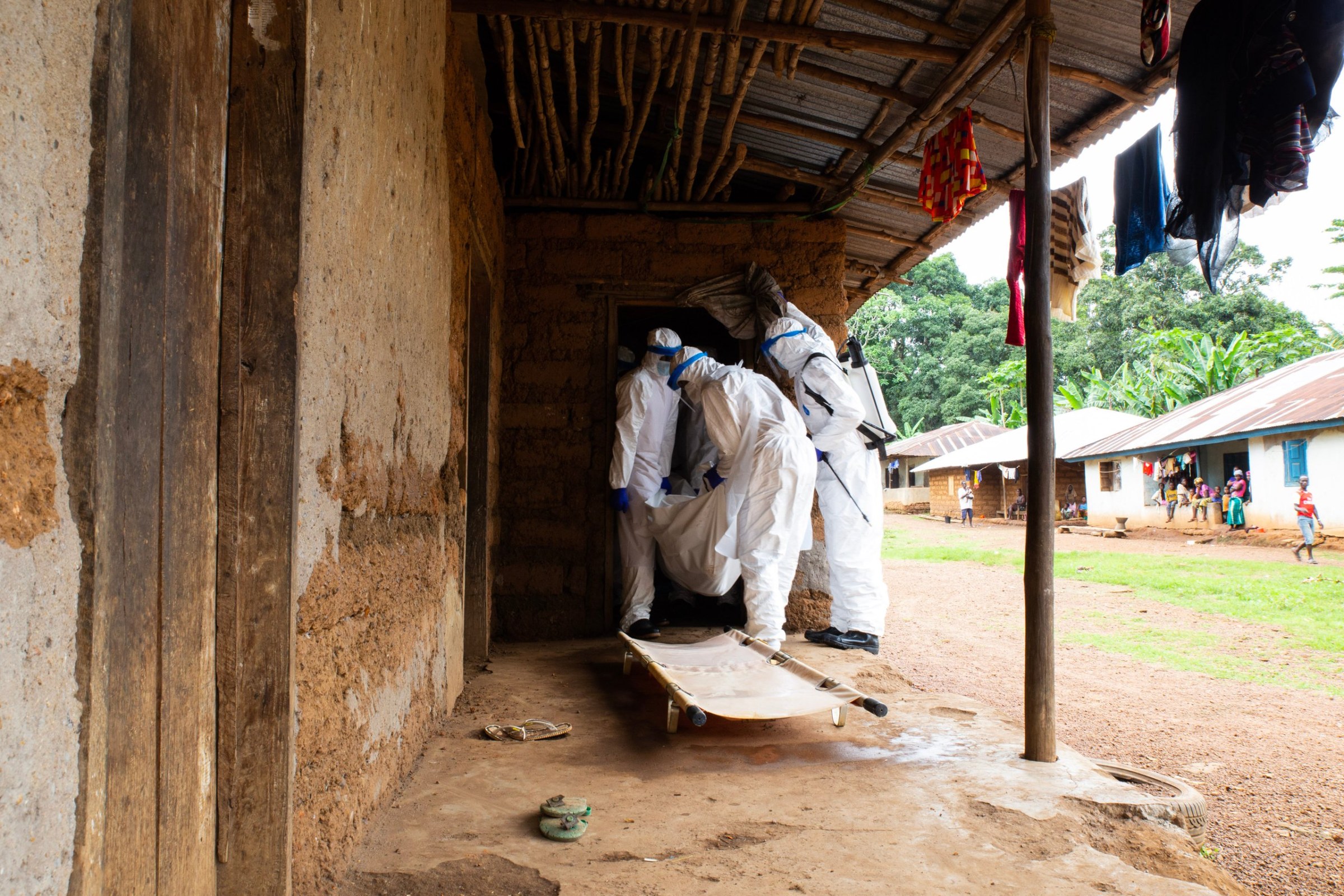
Lunsar, Sierra Leone, June 24, 2015. Photograph by Belen B Massieu. © Belen B Massieu / stock.adobe.com. Editorial use.
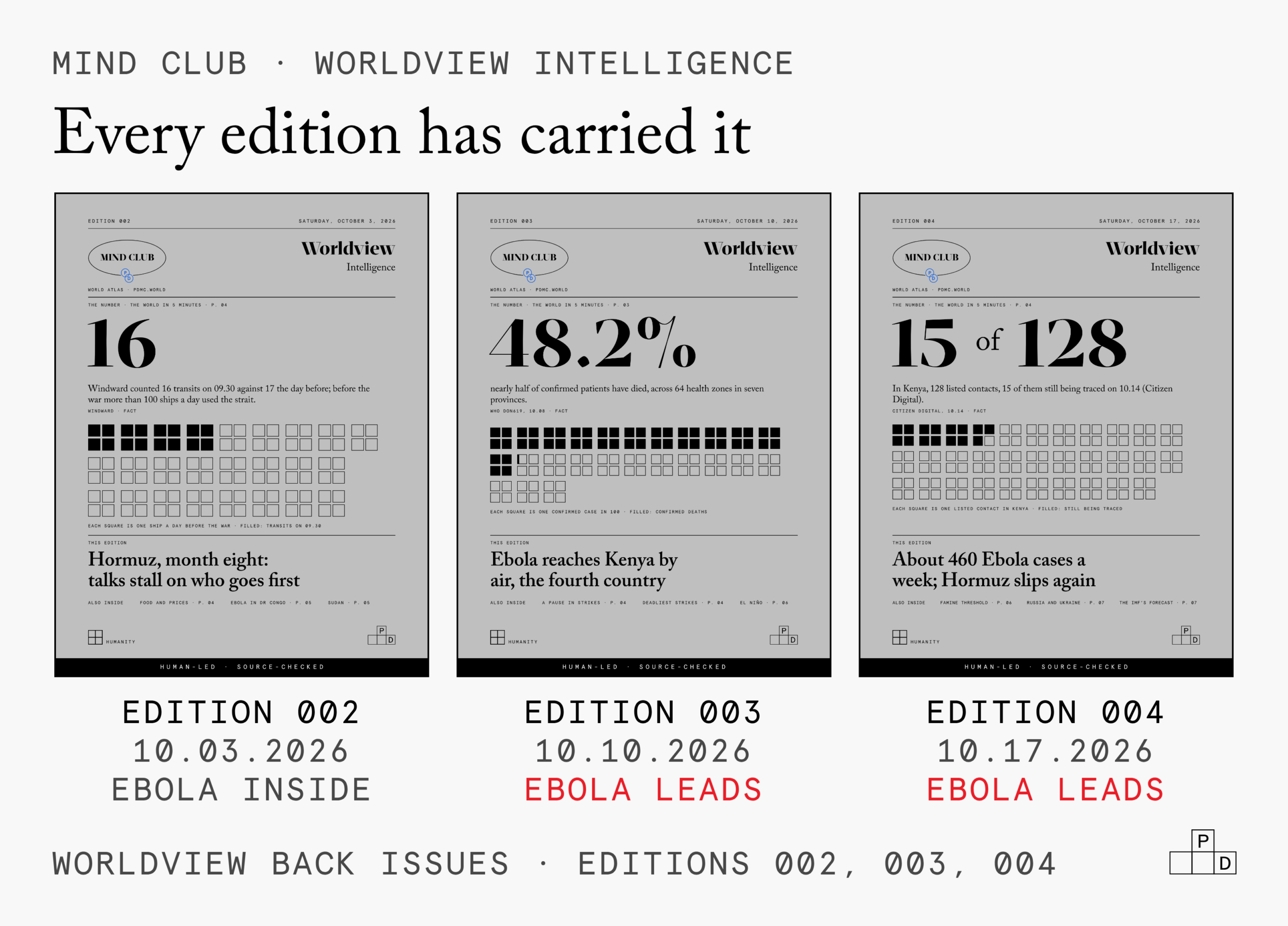
Worldview has been on this since early October
I started Worldview for my own reference, a weekly note to keep track of what I needed to know. It now goes out under Mind Club, by invitation. I have been writing about this outbreak in it since the start of October. Edition 003 led with Ebola reaching Kenya, the fourth country, and put the case fatality rate on its cover: 48.2 percent, across sixty-four health zones in seven provinces. Edition 004 led with about 460 cases a week, and its cover figure was the Kenyan tracing gap, a hundred and twenty-eight listed contacts with fifteen of them still being traced. The October 24 edition led with Nigeria and the start of a vaccine trial. Edition 010 went out this morning and led with it again: the count past eleven thousand, more than a thousand contacts lost. It is the most urgent I have been about this outbreak yet.
I am not pointing that out because the brief is clever. I think the distance between how large this outbreak is and how small a share of the news cycle it holds is the same distance this essay is about. If you want it tracked week by week, Worldview is where I do it, and you can ask me for an invitation.
